How to get customers online for a local business in Miami (without relying only on referrals)
Referrals are the best kind of customer… and the least controllable: they show up when they show up. Meanwhile, your new customers are already looking for you — on their phones, on Google, and in reviews — and they decide within minutes whom to call. This isn't about "doing marketing" in the abstract: these are the 4 steps, in order, to be on that short list when someone searches for what you do near them.
An honest note before we start: getting customers online is not a button you press or a ranking you buy. Google itself says it plainly in its official local ranking guide: "there's no way to request or pay for a better local ranking on Google." Anyone who promises you the top spot in exchange for money is selling you something Google says is not for sale. What does exist is a system — boring, verifiable, and within reach of a small business — and that's what we break down here, fact by fact.
First, how a local customer searches today (the data, not opinions)
BrightLocal, the firm that studies local consumer behavior every year, asked 1,227 U.S. consumers who had searched for a local business in the previous three months how their most recent search went (Consumer Search Behavior, 2026). And in its annual review survey (Local Consumer Review Survey 2026, 1,002 U.S. adults) it measured what they do next. This is the picture that comes out:
| What the customer does | Verified figure | What it means for you |
|---|---|---|
| Searches for local businesses online | 84% did so in the last 3 months | Your new customer almost certainly starts online, not by walking past your door |
| Starts the search on a phone | 73% mobile · 19% desktop · 8% tablet | If your presence fails on the phone, it fails where it matters |
| Starts on Google | 52% on Google Search and 9% on Google Maps; 71% use Google Search at some point | Google is still the front door: that's where you need to be first |
| Doesn't stick to a single channel | 75% used more than one channel in their most recent search | Profile, website, reviews, and social media get cross-checked: they have to agree |
| Reads reviews | 97% read reviews of local businesses; 41% do so always | Without recent reviews, for most people you don't even make the comparison |
| Verifies on your website | After reading positive reviews, the most common action (54%) is visiting the business's website | The review earns the visit; your website decides whether there's a call |
And they decide fast: according to the first part of that same BrightLocal research, most people decide which business to call in under 30 minutes, and 28% in under five. There's no time for them to "find you later": either you're complete and convincing in that moment, or the call goes to the next one on the list.
Step 1: your Google profile, complete and verified
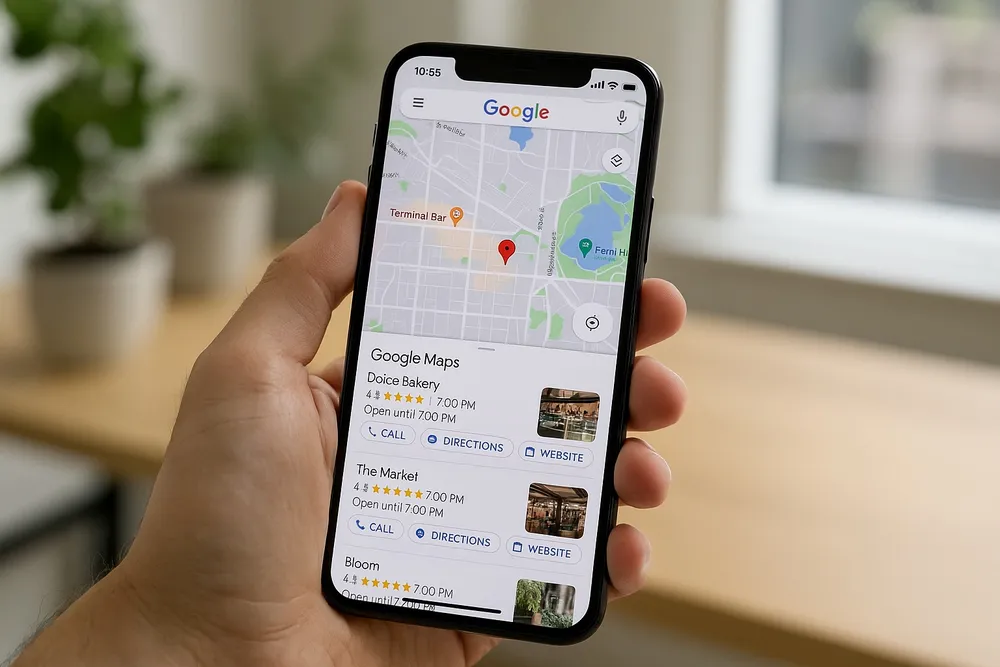
It's step zero, and it's free. Your Google Business Profile is what shows up on Google Maps and in the local business block when someone searches "plumber near me" or "web design for contractors in Miami." Google explains in its official guide that local results are ranked mainly by three factors: relevance (how well your profile matches the search), distance (how close you are to the person searching), and prominence (how well-known your business is, including how many sites link to your website and how many reviews you have). You don't control distance. The other two, you do.
That's why Google insists on the same point in its page on completing your profile: businesses with complete and accurate information are more likely to appear in local results. And it gives its own figures on the complete profile — they're Google's figures, without a published study behind them, so take them as what Google claims, not as an independent measurement: customers are 2.7 times more likely to consider a business with a complete profile reputable, 70% more likely to visit it, and 50% more likely to consider buying from it.
In practice, "complete" means: the right category and services loaded one by one, hours (including holidays), correct phone and website, real photos and videos uploaded regularly, and replies to reviews. If you don't have a profile yet, or yours is half-done, it's the highest-return-per-hour work in this entire article. It is, in fact, a service in itself — that's how we work on the Google Business Profile for clients — but you can do the basics yourself for free.
Step 2: your website, the place where they verify you
Many people think the profile replaces the website. The data says the opposite: the profile puts you on the list, and the website is where the customer verifies whether you're really the right choice. Remember the figure above: after reading positive reviews, the most common action (54%) is visiting the business's website, and two out of three consumers (66%) do more research before buying, versus only a third (34%) who feel ready to hire on the spot.
That verification visit lasts seconds and looks for four things: exactly what you do, which areas you serve, roughly what it costs, and how to reach you in one tap. If your website answers that — with your phone and WhatsApp visible without scrolling, loading fast on a phone — the visit turns into a call. If you have no website, or the one you have contradicts your profile (a different phone, different hours), the verification fails and the customer goes back to the list. In the contractor website checklist we detail, element by element, what that page needs, and in the article on website or just social media we explain why social media alone can't play this role.

Step 3: steady, recent reviews — and replies to all of them
Reviews are no longer decoration: they're the filter. In BrightLocal's 2026 survey, 97% of consumers read reviews of local businesses and 41% do so every time they search for a business (the year before it was 29%). The bar rose, too: 47% wouldn't use a business with fewer than 20 reviews, 74% only take into account reviews from the last three months, and 31% only consider businesses with 4.5 stars or more. In short: accumulating reviews once isn't enough; you need a steady flow of real, recent reviews.

"Reviews are stable, sticky, and more important than ever. […] Even in a world where people are more aware and more frustrated by the scourge of fake reviews, 97% of consumers still lean on reviews to guide their purchase decisions."
And you have to reply to them: 89% of consumers expect the owner to respond to reviews, and 80% say they're more likely to use a business that responds to all of them. Google agrees from its side: responding to reviews and keeping your information accurate is part of its official guide, and it notes that more reviews and better ratings can help your local ranking. The full system — the right moment, the official link and QR code, and ready-to-copy messages — is in our guide on how to ask for Google reviews without breaking the rules. What never works: buying reviews, offering incentives in exchange, or asking only for 5-star ones. Besides being dishonest, it goes against Google's policies, which can remove them.
Step 4: consistency across more than one channel (without going crazy)
The last figure ties it all together: 75% of consumers used more than one channel in their most recent search — Google, maps, social media, review sites, and even AI tools (23% used AI at some point in that search, and in the review survey, AI use for local recommendations jumped from 6% to 45% in one year). It doesn't mean you have to be everywhere posting daily. It means something simpler and more demanding: that what the customer finds in each place agrees. The same name, the same phone, the same services, and the same areas on your profile, your website, and your social media. Inconsistency is what kills the verification in step 2.
This sustained work — profile up to date, a website that answers, reviews coming in, and data that matches — is, at its core, local SEO: not a trick, but being the clearest and most trustworthy option for searches in your area. That's why it works for trade businesses just as it does for shops and salons: the contractor websites that convert aren't the prettiest ones — they're the ones that complete this circuit.
How much does doing this right cost?
With your own time, steps 1, 3, and half of 4 cost $0: the profile is free, asking for reviews the right way is a habit, and unifying your data is an afternoon of work. What usually gets paid for is the centerpiece, a professional website — in Miami it runs between $900 and $2,500, one-time payment, depending on size and features; it's the range we publish and charge ourselves, broken down in the Miami web design pricing guide — and, if you want someone else to keep the system running, monthly maintenance and local SEO. These are the three services most businesses start with:
- Custom design in English and Spanish
- One-tap WhatsApp and calls
- Delivered in 3–7 days
- Your site always up to date and secure
- Content updates included
- WhatsApp support in English and Spanish
- Get found in your area
- Optimized Google Business profile
- Review strategy
Your next-30-days plan
With no agency and no budget, in this order — each step builds on the previous one:
- Week 1 — the profile: claim or create your Google Business Profile, verify it, and complete it in full: category, services one by one, hours, phone, website, and 10 real photos of your work.
- Week 2 — the verification: open your website on your phone as if you were a customer. Can you tell what you do, where, and roughly what it costs within 10 seconds? Can you call yourself in one tap? Fix that first; if you don't have a website, this is the week to decide on one.
- Week 3 — the reviews: get your official review link, generate the QR code, and start asking at the end of every job, at the moment the customer is happy. Reply to every review that comes in.
- Week 4 — the match: compare name, phone, hours, and services across your profile, your website, and your social media, and make them match. From there, the system is consistency: new photos, new reviews, and up-to-date info, every month.
None of this guarantees a ranking or a number of calls — nobody honest can promise you that, and Google itself warns that rankings can't be bought. What it does do is put you on the short list that produces almost all new-customer calls in your area. Referrals will keep coming; the difference is they'll stop being your only source.
Sources
- Google, "Tips to improve your local ranking on Google": local results are based mainly on relevance, distance, and prominence; businesses with complete and accurate information are more likely to appear; more reviews and positive ratings can help; and there's no way to request or pay for a better local ranking.
- Google, "Complete your Google Business Profile": with a complete profile, customers are 2.7 times more likely to consider a business reputable, 70% more likely to visit it, and 50% more likely to consider buying from it (figures stated by Google in its official help); it also notes that soliciting reviews through incentives is prohibited.
- BrightLocal, Consumer Search Behavior: Where are your customers really searching? (2026; representative panel of 1,227 U.S. consumers who searched for a local business in the last 3 months): 84% searched for a local business online in that period; 73% started on mobile; 52% started on Google Search and 9% on Google Maps (71% used Google Search at some point); 75% used more than one channel; AI was used by 23% during the search.
- BrightLocal, Local Consumer Review Survey 2026 (representative panel of 1,002 U.S. adults via SurveyMonkey): 97% read reviews of local businesses and 41% do so always; 47% wouldn't use a business with fewer than 20 reviews; 74% only take into account reviews from the last 3 months; 31% only consider 4.5 stars or more; after positive reviews, 54% visit the business's website and 66% do more research versus 34% ready to buy; 89% expect the owner to respond and 80% are more likely to use a business that responds to all of them; the use of AI tools for local recommendations rose from 6% to 45% in one year. Quote from Myles Anderson, co-founder and CEO of BrightLocal, presenting this survey.
At CafecitoWeb, the audit of your online presence is free: we review your profile, your website, and your reviews the way a new customer sees them, and we tell you which step you're missing — whether you end up doing the work with us or on your own. Request your free audit.
Which of the 4 steps is your business on?
Book a free call and we'll go over it with you, looking at your real profile and website. No commitment — we speak English and Spanish.